lunes, 27 de febrero de 2023

Si me hubiera quedado en Sabana del Medio (Gustavo Coronel)


 Por diez años, entre 1994 y 2003, viví en Sabana del Medio, a unos tres kilómetros del Campo de Carabobo, en una amplia casa “venezolana” que construí con ayuda de trabajadores del lugar (Barrera), con piscina y dos hectáreas de terreno donde planté alrededor de 600 árboles frutales. Mi éxito con los frutales fue moderado porque la tierra allí no es buena para la agicultura y yo no sabía mucho de eso. Recuerdo que por algún tiempo le echaba úrea a los suelos, lo cual era contraproducente. Sin embargo fueron muchos los mangos, las mandarinas, los aguacates, los nisperos, los hicacos y muchos otros frutos (hasta café coseché en la penumbra de la ribera de la laguna)) que mi esposa y yo nos comimos o regalamos a nuestros amigos y vecinos. Planté dos cotoperíes que algún día darán frutos a los hijos de quienes vivan allá. Teníamos apamates plantados por nosotros, creciendo rápido, y un venerable curarí que encontramos allá, al lado de la laguna, el cual nos regalaba cada año, por tres o cuatro días, el maravilloso espectáculo de su florecer. Espero que todavía esté de pié porque el comején lo tenía agobiado hasta que logramos hacerle un tratamiento a fondo. La laguna estaba llena de peces y de babillas y, en la tarde, me sentaba en el amplio corredor de la casa, a ver pasar centenares de cotúas (negras) y garzas(blancas) las cuales iban a dormir en árboles vecinos, no en el mismo árbol, ya que parecían practicar una segregación racial más severa que en Missisipi. Adquirí una parabólica que me permitía ver hasta las telenovelas de Hong Kong, las cuales disfrutaba mucho, precisamente porque no podia entender los diálogos. El joven ingeniero, muy agradable, quien me mantenía conectado al mundo mediante un pago importante al año, desapareció un día, se fué con la cabulla en la pata y me dejó viendo la vecindad del chavo.

Solíamos estar en la piscina en la noche, bajo las estrellas, flotando arrullados por el romántico mugido de las vacas que se comían nuestras cayenas hasta que nosotros, en justa retribución, nos comimos a una de ellas. Fui presidente por dos o tres períodos consecutivos de la Asociación de Propietarios de Sabana del Medio, un grupo de soñadores que deseaban ser campesinos civilizados, como existen en los países más desarrollados. Sin embargo, los obstáculos eran formidables, comenzando por Eleoccidente, ese monstruo inepto y sádico que es causa probable de centenares de infartos al año. En efecto, cada semana fallaba la luz eléctrica y entonces yo debía salir a Tocuyito, a las oficinas de la empresa para demandar la restitución del servicio. Generalmente ello solo era posible cuando yo llegaba a la etapa de amenazar con pegarle candela a la oficina, con todos sus “burrócratas” indiferentes y retrecheros adentro.
Del grupo de parceleros recuerdo con especial afecto a Jesus Pulido, gran idealista y trabajador por el bienestar de todos nosotros y a Raimundo Cariello y su bella familia, quienes han perseverado y están allá todavía, con su Planeta Zoo, que ofrece una de las pocas alternativas de distracción para los niños de la zona. Saludos, Raimundo, María Alexandra, Lola, muchachas, venados y boas constrictoras!
Mál que bien logramos estabilizar a Sabana del Medio hasta la entrada del nuevo siglo, el cual coincidió con la llegada de la “revolución”. Desde ese momento comenzó un movimiento de “democratización” del agro, el cual consistía en promover invasiones de los pobres a tierras privadas que tuvieran o no en producción. Ese movimiento estuvo acompañado por la puesta en duda de la propiedad de nuestras parcelas. El INTI comenzó a pedirnos los papeles de propiedad de las parcelas desde la llegada de Colón a nuestras costas. Por supuesto, más vale un bolsa preguntando que un sabio respondiendo y pronto nos dimos cuenta que lo esa gente quería era plata. Superamos ese escollo de la manera venezolana tradicional.
Poco a poco las invasiones nos rodearon. Ya podía ver los ranchos construídos de manera precaria desde mi casa. Mis aspiraciones de vivir civilizadamente se fueron evaporando rapidamente. En paralelo, a los vecinos comenzaron a asaltarlos los malandros. Un día a los Cariello los amarraron y le robaron dinero y objetos de valor. Luego le tocó el amarre a mis vecinos los Betancourt, saqueo completo a mis otros vecinos los Brunicardi y asalto a mi otro vecino, un señor quien era suegro de un alto oficial de la guardia nacional y tenía “protección”. Inclusive los malandros asesinaron a un parcelero cerca del campo de Carabobo, un hermano de una señora llamada Blanca, muy chavista ella, creo que es embajadora de Chávez en Europa pero ni de vaina visita el municipio Libertador!
A mí me respetaron y creo que mi apellido me sirvió de escudo. Los malandros, generalmente muy ignorantes, pensaban probablemente que yo era un Coronel, no Coronel de apellido y que debía estar armado hasta los dientes. Nunca tuve un arma en la casa, hasta que le compré una escopeta a mi cuidador.
Ya para 2003, cuando regresé de un trabajo que me mantuvo dos años en Margarita (ese es otro cuento), la situación en Sabana del Medio era insoportable. La zona de Tocuyito estaba saturada de malandros y asesinos. Los servicios públicos colapsados. La gente honesta desolada, los sueños rotos. Cuando salía de mi casa, limpia y organizada por dentro, debía enfrentarme a la realidad de la zona: invasiones y ranchos por doquier, suciedad, caos, criminalidad, escasez de alimentos de calidad. Los vegetales del mercado al aire libre de Tocuyito eran muy melancólicos, prematuramente envejecidos, tantos los vegetales como quienes los vendían. Algunas veces los atraques de tránsito en el polvoriento pueblo eran desesperantes. Ir al banco en Tocuyito era como entrar a la sala de emergencias del Pérez de León: cuanta angustia, cuanto desorden. Al salir del pueblo había que enfrentarse con los lóbregos edificios de la cárcel, donde uno sabía que gente sufría y moría a diario.
No que todo fuera desastroso. La vida rural venezolana tiene o tenía sus encantos. Aún mi esposa y yo podíamos tomar carretera y estar en Santo Domingo en unas seis horas, o seguir hasta el hotel Los Frailes y echarnos un baño de decencia que nos hacía olvidar a nuestro infierno. O nos íbamos a comprar dulces en La Carolina, a menos de una hora de camino por los bellos valles de Bejuma y Montalbán. Pero luego comenzaron los asaltos en las carreteras hasta el punto en que no nos atrevimos a viajar más.
Había llegado la hora de partir. Salimos de Sabana del Medio sin mirar atrás, llenos de dulces memorias, sabiendo que había sido nuestro hogar por diez años y que habíamos compartido con buenas y amables familias un sueño de civilización rural que, al menos para nosotros, no se pudo concretar. Se nos vino encima el comején político y social.
Si me hubiera quedado en Sabana del Medio ya estaría muerto o en la cárcel de Tocuyito. Me hubieran asesinado unos desconocidos para robarme la camioneta, como casi me sucedió en La Encrucijada, mientras me comía una arepa, o estuviera preso por haberle pegado candela a las oficinas de Eleoccidente. Cuando veo las estadísticas para 2010 del crimen en el municipio Libertador (ver mapa) estoy convencido de que yo hubiera estado incluído en esa obscena cosecha de la muerte, la cual ha convertido a mi patria en un sitio no apto para la vida civilizada.
Hoy solo visito a Sabana del Medio con la imaginación, ayudado por Google Earth, programa con el que creo poder ver hasta el que era mi hogar. Lo que no puedo ver bien es si los cotoperíes han crecido!

Postal Sabana del Medio (Gustavo Coronel)


Durante la década de los 90 me fuí con mi esposa a vivir a Sabana del Medio, una urbanización rural cercana a Valencia, la obra de un emprendedor valenciano llamado Luis Ugarte. Con el dinero de la venta de un pequeño apartamento en Cerro Verde, en Caracas, compramos dos hectáreas de terreno en Sabana del Medio e hicimos una casa de 400 metros cuadrados, con piscina, gran jardín donde sembramos 600 matas frutales y árboles de sombra y construímos caminos interiores y un parrillero. Era, así lo creo, un mini-paraíso, eso sí, caluroso y afligido por las contínuas interrupciones del servicio eléctrico de la inepta Eleoccidente. En todo caso, mi esposa y yo fuímos felices allá, aunque nos dímos cuenta rapidamente que la tierra no era fértil, aunque si lo suficientemente buena para aguacates, cítricos y algunas otras especies frutales. El caujíl rojo y amarillo se daba salvaje y teníamos un riachuelo al costado de la casa que tenía agua durante todo el año, lleno de pequeñas babas y peces variados. La comunidad era pequeña, de gente emprendedora, auqnue la mayoría de los vecinos no vivían allá sino que tenían casas de fin de semana, pués vivían en Valencia o Maracay. Algunos habitantes de Sabana del Medio hicieron extraordinarios aportes a la comunidad. Tengo un agradable recuerdo de Jesús Pulido, Raymundo Cariello y de un maravilloso señor italiano quien se ofreció, sin conocerme, como garante de mis compras para la construcción de nuestra vivienda.

Poco a poco, sobre todo después de 2000, se fueron imponiendo las duras realidades de la zona: atracos, invasiones, ranchificación, hasta asesinatos de gente conocida. En la vecina Barrera existían siete botiquines pero no una biblioteca pública o un cine. La cercanía del Penal de Tocuyito no era tranqulizadora. Los vegetales del mercado eran cada vez más melancólicos. Nunca pudimos tener un teléfono, hasta que llegó el primer celular. El Internet llegó tarde y luego desapareció. Fracasamos en un intento de convertir una posada muy bella, propiedad de Luis Ugarte, en un centro de entrenamiento para los empleados de la General Motors. Decepcionados por la sensación de haber perdido nuestra “Shangri La”, salimos de Sabana del Medio en 2003.

Hoy veo una noticia sobre Sabana del Medio que me entristece:

“A las 4:00 pm del jueves, los juegos y las actividades recreativas que realizaban los 150 niños del plan vacacional del Banco de Venezuela fueron interrumpidas por siete hombres armados que irrumpieron de forma violenta en la agropecuaria Sabana del Medio, ubicada en el sector Barrera del Municipio Libertador del estado Carabobo. El grupo, conformado por los menores de edad y 30 adultos, se encontraba en esta finca disfrutando del receso escolar con actividades organizadas por le empresa en que trabajan sus padres. Durante una de sus actividades del jueves en la tarde fueron sometidos por los delincuentes, quienes portaban armas largas. Según fuentes extraoficiales, los visitantes provenían de Caracas y se encontraban en la agropecuaria, situada en el sector Tocuyito de Carabobo, muy cerca de la frontera con Cojedes.


Los 7 delincuentes primero sometieron a las personas que se encontraban en la entrada, custodiando el acceso al lugar, y posteriormente amenazaron con escopetas y revólveres a los niños y sus acompañantes. Los despojaron de teléfonos celulares, dinero en efectivo y otras pertenencias, y afortunadamente ninguna de las víctimas resultó herida.

Pienso que este asalto a niños es una prueba más del envilecimiento que se ha apoderado de nuestro país, enviándolo de golpe y porrazo a escalones inferiores del desarrollo y del bienestar social. Venezuela se ha convertido en un país dominado por la delincuencia, fuera y dentro del gobierno. Pienso hoy en Sabana del Medio y en el sueño que tuvimos de hacerlo un paraíso.
Que difícil es hacer progresar a Venezuela!


viernes, 24 de febrero de 2023

Stabroek block, Guyana, new oild discovery: Fangtooth (By Melisa Cavcic)


U.S.-headquartered energy giant ExxonMobil has made a significant new oil discovery at the Stabroek block, which boosts the block’s hydrocarbon resources, fortifying the oil major’s existing portfolio of extensive development opportunities offshore Guyana.

The new oil discovery, made at the Fangtooth SE-1 well on the Stabroek block, was disclosed on Wednesday, 25 January 2023, by ExxonMobil’s partner on the block, Hess Corporation. The Stabroek block covers 6.6 million acres (26,800 square kilometres) and is operated by ExxonMobil’s affiliate Esso Exploration and Production Guyana with a 45 per cent interest. The company’s partners in the block are Hess Guyana Exploration (30 per cent), and CNOOC Petroleum Guyana (25 per cent).

According to Hess, the Fangtooth SE-1 well encountered approximately 200 feet of oil bearing sandstone reservoirs. This well was drilled in 5,397 feet of water by the Stena Carron drillship. ExxonMobil’s new discovery is located approximately 8 miles southeast of the original Fangtooth-1 well, which had encountered around 164 feet of oil bearing sandstone reservoirs.

Hess confirmed that further appraisal activities were underway, highlighting that Fangtooth would add to the Stabroek block’s gross discovered recoverable resource estimate of more than 11 billion boe. The firm further underscores that this has the potential to underpin a future oil development on the block.

The new discovery adds to the continued exploration success offshore Guyana, as ExxonMobil has made over 30 discoveries on the block since 2015. The U.S. oil major’s first two sanctioned projects off Guyana are Liza Phase 1 and Liza Phase 2, which are producing above design capacity and are currently operating at a combined gross production capacity of more than 360,000 barrels of oil per day (bopd).

ExxonMobil’s third project, Payara, is on track to come online by the end of 2023 with a gross production capacity of approximately 220,000 bopd, using the Prosperity FPSO. The U.S. player’s fourth project, Yellowtail, is expected to be on stream in 2025 with a gross production capacity of roughly 250,000 bopd, using the ONE GUYANA FPSO.

In addition, ExxonMobil submitted for approval a plan for a fifth development, Uaru, to the government of Guyana in the fourth quarter. Pending the government’s approvals and project sanctioning, this project is expected to have a capacity of approximately 250,000 gross bopd with the first oil anticipated at the end of 2026.

A few months ago, Japan’s MODEC secured a FEED contract for Uaru FPSO. The firm will design and construct this FPSO based on its M350 newbuild design, which will be able to produce 250,000 barrels of oil per day, will have an associated gas treatment capacity of 540 million cubic feet per day, and a water injection capacity of 350,000 barrels per day.Melisa Cavcic, Jan 2023.

lunes, 14 de febrero de 2022

Keystone XL pipeline is officially dead. What does this mean for Canada? By Katie Dangerfield Global News


Keystone XL, a US$8-billion oil pipeline that was set to flow from Alberta to Nebraska, is officially scrapped, the project’s owner, TC Energy, confirmed on Wednesday.


Although Alberta is now on the hook for more than $1 billion in lost profit after the cancellation of the expansion pipeline, there is division over the impacts of its termination. Industry experts are concerned about the waterfall effects on the Canadian economy, while environmentalists tout the cancellation as a win.


READ MORE: TC Energy terminates Keystone XL pipeline months after Biden revokes permit


“Canada has the oil, but now we have fewer options to get the oil out,” explained Richard Masson, an executive fellow at the University of Calgary’s School of Public Policy.


“Keystone would have provided more flexibility for oil producers, but without it, refineries in the Gulf Coast may turn to other producers, like Saudi Arabia or Columbia, for the product.”


STORY CONTINUES BELOW ADVERTISEMENT


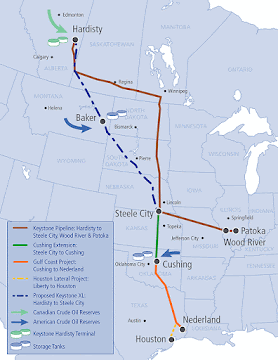
Keystone XL, a 1,947-kilometre pipeline, was designed to carry 830,000 barrels a day of crude oil from Hardisty, Alta., to Steele City, Neb. From there, it would connect with the company’s existing facilities to reach the U.S. Gulf Coast — one of the world’s biggest oil refining hubs.


A route map for the proposed Keystone XL pipeline.View image in full screen

A route map for the proposed Keystone XL pipeline. Courtesy: TransCanada

But TC Energy, the Calgary-based company, cancelled it after conducting a comprehensive review of its options and consulting with the Alberta government. This comes months after U.S. President Joe Biden revoked a key permit needed for a U.S. stretch of the 1,200-mile project.


Keystone’s demise follows the cancellations of Northern Gateway and TransCanada Corp.’s Energy East, as well as a delay in Trans Mountain, which the Canadian government bought in 2019 for $4.5 billion from Kinder Morgan.


Although the cancellation is a win for environmental groups and many Indigenous communities, there’s still an impact on Canada, including a loss of revenue and jobs and a need for more reliance on rail to ship the product.


Loss of revenue

Oil sands are a huge resource in Canada. The country is the fourth-largest producer and third-largest exporter of oil in the world, according to the federal government.


And despite the cancellation of the Keystone pipeline, the demand for Canada’s oil is still there, Masson said.


He explained that over the past few years, Canada has produced a lot of oil but because of a lack of pipelines, it meant the product was not getting it out to refineries, meaning Alberta had to cut back its production of oil.


“Which means a loss of revenue because we could not get it to market,” he said.


“We have a situation, where COVID is mostly done and oil sands have ramped up production and shipping 200,000 barrels a day plus a day by rail because we don’t have the pipeline capacity, which is more expensive,” Masson said. “Keystone would have provided more flexibility for oil producers.”


If all the pipelines are full, then refineries can push prices lower and producers in Alberta “don’t have a choice,” he added.


Refineries, especially in the Gulf Coast, he said, have the ability to bring in crude oil via ship, so they have the option to take someone else’s oil if they don’t like the price Alberta is charging.


“So Keystone was not needed immediately, but was part of getting back in better balance so we have options to reach different markets and we wouldn’t end up with big disruptions or too much price pressures for buyers.”


Oil will still ship, but through rail

According to the federal government, as production of oil increased in Western Canada in 2018, it began to outpace pipeline capacity, meaning shipments of crude oil by rail increased to fill the gap, more than doubling from their 2017 levels.


And with the cancellation of the Keystone pipeline, Canada’s reliance on rail to ship oil has increased, Masson said.


But, transporting crude oil by rail is a lot riskier and costlier than using pipelines.


READ MORE: Study says lack of pipeline capacity costing Canada billions in lost revenue


For example, he said the Keystone pipeline would have cost $10 to $12 a barrel to get oil to Gulf Coast from Alberta, while rail would cost $20. On top of that, Masson said with more oil shipping through rail, that means there’s more a chance of derailment and winter storms impacting supply.


“So generally it’s more expensive, which could mean less oil from Canada and more oil from other places,” he said.


“Many environmentalists see cutting off pipeline as cutting off oil supply, but the reality is that if you cut off oil supply from Canada, the oil will still move, but in a less efficient and less safe way.”


A win for environmentalists

The Keystone project has been tangled in a decade-plus battle that pitted the energy industry against environmentalists and many Indigenous communities opposed to the pipeline.


After its official cancellation on Wednesday, many environmentalists welcomed its demise, calling it a landmark moment in the fight against climate change.


“This victory is thanks to Indigenous land defenders who fought the Keystone XL pipeline for over a decade,” said Clayton Thomas Muller, Canada senior campaigns specialist at 350.org, in a statement.


“With Keystone XL cancelled, it’s time to turn our attention to the Indigenous-led resistance to the Line 3 and the Trans Mountain tarsands pipelines.”


Many environmental groups, like 350.org., were fiercely opposed to the project, seeing the reliance on oil and gas as incompatible with limiting carbon emissions. The pipeline’s proposed path was also criticized for endangering wildlife and destruction of habitats.


The organization, named after the safe concentration of carbon dioxide in the atmosphere, said its efforts were never about just one pipeline.


“The termination of this zombie pipeline sets precedent for President Biden and polluters to stop (Enbridge Inc.’s ) Line 3, Dakota Access, and all fossil fuel projects,” added ground campaign manager Kendall Mackey.


Fewer jobs

While some Indigenous groups opposed the pipeline, some communities see oil and gas development as a solution to poverty on reserves.


Dale Swampy, president of the National Coalition of Chiefs, had complained in January that its cancellation would mean fewer jobs for Indigenous people in constructing and supplying goods and services for it.


“It’s quite a blow to the First Nations that are involved right now in working with TC Energy to access employment training and contracting opportunities,” Swampy told the Canadian Press in January.


“Within Alberta, First Nations are pretty closely entrenched with all of the activities occurring with the oil and gas industry. Any change, especially a big change like this, really affects our bands’ ability to keep our people employed.”


Alberta on the hook for $1.3 billion

Alberta Premier Jason Kenney announced Wednesday that the province is expected to be out $1.3 billion following the decision by TC Energy Corp.


Lori Williams, a political science professor at Mount Royal University in Calgary, said the number may actually be higher, costing Albertans way more in taxes.


“(The government) has given us an estimate of what the cost will be. My guess is that it’s a low estimate,” she said.


“Basically, it’s all over except for the counting of how much it’s going to cost Albertans. It’s going to hurt the government. It’s going to raise questions about Jason Kenney’s judgment — investing so much money in a project that had a significant chance of not continuing.”


— with files from the Canadian Press and Reuters


© 2021 Global News, a division of Corus Entertainment Inc.


jueves, 26 de noviembre de 2020

Veronica Penney about Line 5 Pipeline at Michigan. (NYT)


 In an unusual move, Gov. Gretchen Whitmer of Michigan, citing environmental concerns, is shutting down an underwater pipeline that carries oil to refineries in her state and Canada.

Pipeline operations normally fall under federal jurisdiction. Governor Whitmer, a Democrat, is acting under the state’s public trust doctrine, which requires state authorities to protect the Great Lakes. The pipeline in question, known as Line 5, has been in operation since the 1950s.

The decision, announced on Friday, requires the pipeline operator Enbridge to cease operations on a specific section of Line 5 by May 2021, but it will have the effect of curtailing the entire pipeline, which runs between Superior, Wis., and Sarnia, Ontario.

“Enbridge has routinely refused to take action to protect our Great Lakes and the millions of Americans who depend on them for clean drinking water and good jobs,” Governor Whitmer said in a statement.


Under the terms of an agreement with the state, Enbridge is required to maintain a multilayered coating on the pipeline to protect it from corrosion and to ensure that the pipeline has physical supports that are no more than 75 feet apart. The Michigan authorities found that the company had violated those terms and also failed to adequately protect the pipeline from damage from boat anchors.

While the line moves a relatively small quantity of oil — about 540,000 barrels of light crude oil and liquid natural gas each day, compared with national average consumption of 20 million barrels of crude oil per day — environmentalists applauded the move. While it was not clear that the legal strategy could easily be applied to other pipelines, they also said it was significant in that it focused on an older pipeline rather than a new project.

“I think this Line 5 decision is going to spark some interest in existing pipelines,” said Jared Margolis, a senior attorney with the Center for Biological Diversity. “I think, at some point, we do need to turn to pipelines that are in the ground that are dangerous, that are posing a serious risk.”

Governor Whitmer’s action will revoke the 1953 easement that allows Enbridge to operate pipelines through the Straits of Mackinac, a narrow waterway that connects Lake Michigan and Lake Huron.

A spokesman for Enbridge said the decision could have “devastating” economic consequences.

“Enbridge remains confident that Line 5 continues to operate safely and that there is no credible basis for terminating the 1953 easement allowing the Dual Line 5 Pipelines to cross the Straits of Mackinac,” the spokesman, Michael Barnes, said. “Line 5 is an essential source of energy for not only Michigan but for the entire region including Wisconsin, Indiana, Ohio, Pennsylvania, Ontario, and Quebec.”

Opponents of the move also said they worried that an abrupt shutdown would disrupt oil supplies, forcing nearby refineries out of business and disrupting the propane supplies to Michigan’s Upper Peninsula, where many rural residents rely on propane to heat their homes.

“Shutting down Line 5 would kill thousands of jobs in Michigan, severely impact manufacturing and cost our economy hundreds of millions of dollars when the state is already reeling from a pandemic,” said Mike Johnson, the vice president of government affairs at the Michigan Manufacturers Association.

study commissioned by the National Wildlife Federation, however, found that the economic impact for Michigan oil producers of shutting down Line 5 would be minimal and that other shipping methods like trucking would keep refineries running.

“There are alternatives to moving that oil,” said Margrethe Kearney, a senior attorney at the Environmental Law and Policy Center. “I think that we should be really careful and really skeptical of arguments by Enbridge that shutting this pipeline down will result in some dire circumstance and that the sky will fall.”

The decision came after nearly a decade of political pressure. According to Ms. Kearney, a 2010 oil spill on another Enbridge line in Michigan, which poured nearly 850,000 gallons of tar sand into the Kalamazoo River, piqued public interest in Line 5 and other pipelines.

“It’s a very iconic part of Michigan’s culture,” Ms. Kearney said of the area. “So when people realized there’s this oil pipeline down there, it was a really big deal.”


A version of this article appears in print on Nov. 18, 2020, Section A, Page 14 of the New York edition with the headline: Citing Risks, Michigan Shuts Down Oil Pipeline

jueves, 25 de junio de 2020

Mr. Ken Wetherell según José Giacopini Zárraga (Fuente: Dr. Gustavo Coronel)

Un perfil de José Giacopini hecho por Ken Wetherell


José Giacopini Zárraga

En 2013 visité a Kenneth Wetherell en su casa situada en Dorchester, una bella aldea cercana a Oxford, ver: http://lasarmasdecoronel.blogspot.com/2013/09/40-years-later-visiting-ken-wetherell.html.  Fue la última vez que nos vimos, ya que mi querido amigo murió meses después. Pasé todo el día con él, caminando por las calles de la aldea, visitando la bella capilla de la aldea y conversando sobre Venezuela. Buena parte de ese tiempo fue utilizado por Ken para hablarme de algunos de nuestros amigos comunes. En especial, sobre José Giacopini Zárraga. Me confesó que, a su partida de Venezuela, había escrito un obituario de José pensando que no viviría mucho más tiempo,  pero, en efecto, José vivió unos 25 años más, hasta los 90 años (1915-2005). Las notas que siguen son parte de ese obituario que nunca tuvo ocasión de publicarse.
                              
José Antonio Giacopini Zárraga
José, o Giaco, como lo llamaban sus amigos, nació en Caracas en 1915 en el seno de una familia bien. Se graduó de abogado pero nunca ejerció la profesión. Sus contactos familiares le abrirían muchas puertas. A los 24 años fue secretario de la presidencia de Venezuela y me dijo que, en una ocasión, había manejado al país por varios días,  casi solo, durante una transición. A los 26 años fue nombrado Gobernador del Territorio Amazonas y es todavía recordado allá por haber importado los primeros tractores.

En su juventud José llevó la vida un tanto disipada de la Caracas de clase alta. Nunca perteneció a un partido político. Su rama paternal era muy republicana y su rama materna muy apegada a la autoridad, por lo cual desarrolló una habilidad para mantenerse entre esos dos campos. Llegó a ser visto como alguien independiente, discreto, respetado, confiable. Podía hablar con grupos extremos y conciliarlos. Se convirtió en un consejero preferido por políticos, empresarios y militares.

José sabía cómo reparar orgullos ofendidos y con quien hablar para resolver conflictos. Siempre estaba en estrecho contacto con la gente en el poder, con quienes creían estar en el poder y con quienes deseaban estar en el poder. Se convirtió en un diplomático universal, conocido por todos en todo el país, los poderosos y los humildes. En una ocasión viaje con él al estado Apure y aterrizamos en un pequeño poblado para reabastecernos de gasolina. A los pocos minutos llegaron los habitantes a saludar a su amigo José. De mí ni siquiera se ocuparon.

José carecía de malicia. Siempre simpatizaba y le daba la razón a su interlocutor, quien era tratado con extrema, casi exagerada, cortesía, no importaba su rango social. En la década de 1940 comenzó su carrera con Shell en Relaciones Públicas, era lo lógico. Siempre mantuvo una excelente relación con el dictador Pérez Jiménez y hasta fue parte de su último gabinete, por breves días antes de su caída. No sabía decir que no. José continuó en Shell, como confidente, negociador y consejero de sus presidentes. Como Ejecutivo José no tenía la menor habilidad pero siempre fue un extraordinario conciliador. Nunca escribió un Memo. En su escritorio conservaba una foto de Jacqueline Kennedy. No importaba el tema tratado, José siempre figuraba como protagonista y nos narraba anécdotas relacionadas con el tema donde él había jugado un papel importante, lo cual – además -  era cierto. Era invitado a innumerables eventos sociales, en los cuales tomaba solo agua con unas gotas de amargo de angostura el llamado cóctel Giacopini Especial. En cada evento permanecía unos 30 minutos pero hablaba con todo el mundo, quienes recordaban al día siguiente que José les había dedicado mucha atención. Tenía algunos chistes listos para cada ocasión.

Aquí, interrumpo yo, Gustavo, para recordar uno de esos chistes que ofreció a un grupo en el cual me encontraba:

Un señor desarrolló una fuerte dispepsia y el médico le recomendó que volviese a tomar leche materna, para lo cual contrató una nodriza, muy joven y bella. Cuando el paciente comenzó a “alimentarse” la joven se fue poniendo cada vez más excitada. El paciente se le quedó mirando y le preguntó: ¿“Podría usted hacerme un favor”? Y la joven le respondió, ruborosa: “Pídame lo que usted quiera”. A lo cual el paciente respondió: ¿“Me podría buscar unas galletitas”? 

Tenía otro que involucraba una yegua y unas monjas que considero no apto para figurar aquí.
Continuó Ken diciendo: “Cuando la nacionalización tomó lugar, José se convirtió en el asesor político y consejero del general Rafael Alfonzo Ravard, cargo que conservó desde 1976 hasta 1993. La última vez que lo vi, en Agosto 1993 fuimos a almorzar y durante el almuerzo fue objeto de muchos saludos por parte de todos los comensales en el restaurant. Cuando le comenté sobre su popularidad me dijo que se debía a que “cuando visitaba el zoológico nunca hablaba mal de los caimanes”.

José era muy eficiente y efectivo, sin tener poder, riqueza o influencias significativas. No era un gran organizador ni un gran comunicador de ideas. Quizás su gran cualidad fue la amistad, sencilla y sincera. Como resultado, no importaba el favor que él pudiera pedirle a alguien, ya sea desagradable o complicado, siempre obtenía una respuesta favorable. Todo el mundo se desvivía por complacerlo.
José fue un genio de la amistad.

Hasta aquí el perfil de José que me pintó Ken Wetherell. Ken, muy inglés, tenía una cordialidad y sencillez especial. Fue muy religioso y amó mucho a Venezuela y a Colombia. Escribió una Historia de Cartagena, la cual no he podido conseguir. Cuando lo visité en Dorchester tenía ya un Parkinson avanzado. Fuimos a tomar el té y nos sentamos el uno frente al otro. Yo comencé a tomar mi té y, de repente, vi que él no tomaba y comprendí la razón. Tomé su taza y se la acerqué sus labios, una y otra vez, hasta que ambos – conversando - tomamos nuestro té. Todo fluyó con perfecta naturalidad entre quien había sido el poderoso presidente de Shell Venezuela y quien había sido, alguna vez,  uno de sus jóvenes empleados.

La vida nos había igualado en la amistad.

© 2019, Gustavo Coronel. All Rights Reserved.
 

martes, 17 de septiembre de 2019

Can renewable energy power the world? (Bloomberg)

The chief executive of the world’s largest private coal company sat before a group of U.S. lawmakers who wanted to know whether the fuel had a future. He didn’t hesitate. “Coal,” he said, “is the future.”
It was 2010. Coal supplied nearly half of America’s power, the executive testified, and was growing more than 1.5 times faster than oil, natural gas, nuclear and renewables combined. Global demand was on pace to rise 53% within two decades. And renewable energy? Not an option. “Wind and solar comprise just 1% of today’s U.S. energy mix,” Gregory Boyce, then the chief executive of Peabody Energy Corp., told the members of Congress. “It is unrealistic to suggest that renewables could replace conventional baseload fuels.”
Not quite. This April, for the first time ever, renewable energy supplied more power to America’s grid than coal—the clearest sign yet that solar and wind can now go head-to-head with fossil fuels. In two-thirds of the world, they’ve become the cheapest forms of power.
Solar and wind will power half the globe by 2050, based on BloombergNEF forecasts. By that time, coal and nuclear will have all but disappeared in the U.S., forced out by cheaper renewables and natural gas.

Solar and Wind Take Off as Coal Fades Away

● New plant added during 5-year period
 Existing plant
Coal plants
2005
2010
2015
2020
Solar and wind plants
2005
2010
2015
2020
By 2025, renewable power plants will greatly outnumber non-renewable plants, but still won’t have the same capacity level
Plants sized by total MWh: 2K
6K
● Plant in development, 2021–2025
○ Existing plant
Plant type:
● Coal
 Oil & Gas
 Nuclear/other
 Wind
 Other renewables
 Solar
Offshore wind farms are planned for the Atlantic coast
California has so much day-time solar power that it sometimes ships some of it to other states.
Abundant wind power in Texas has made the Lone Star state the biggest wind state
Source: BloombergNEF
The market triumph of renewable energy marks the biggest victory yet in the fight against global warming. Solar and wind are proliferating not because of moral do-gooders but because they’re now the most profitable part of the power business in most of the world. An industry that once relied on heavy subsidies and was propped up by government mandates is now increasingly standing on its own.
As a recent United Nations report put it: The renewable energy sector is “looking all grown up.”

U.S. Energy Emissions by Sector

Metric tons of carbon dioxide
2B
Transportation
Electric power
Industrial
1B
Residential
Commercial
0
2018
1973
In the effort to slow climate change, the energy sector matters. Electricity generation has traditionally been the world’s biggest source of greenhouse-gas emissions. In the U.S., for the first time since the 1970s, this is no longer the case. Since 2016, American power plants have given off less carbon dioxide than the nation’s transportation sector, where oil continues to dominate. The turnabout owes a lot to cheap and cleaner-burning natural gas, but wind and solar farms are playing an increasingly important role.
Solar, wind and hydropower resources combined generate more than a quarter of the world’s electricity. In China and India that share will surpass 60% by 2050, BNEF estimates show, and Europe will top 90%.
Renewable energy won’t save the world on its own. Power generation accounts for about a quarter of greenhouse-gas emissions being released into the atmosphere in the U.S. The rest comes mainly from transportation, manufacturing, agriculture and heating and cooling homes and businesses.
Those sectors will need to match the sweeping technological advances and more efficient manufacturing that have slashed the costs of solar and wind power. Battery prices have fallen 84% in less than a decade. Cheaper parts are what have made solar and wind more economical to build than coal and gas plants across two-thirds of the world. Five years ago, by BNEF’s count, this was virtually nowhere.

Cheapest Energy Generation Technology By Country

2014
2019
Coal
Wind
Solar
Coal
Gas
Wind
Solar
Gas
Belgium
Algeria
Denmark
Indonesia
Algeria
Argentina
Australia
Argentina
Bulgaria
Germany
Belgium
Chile
Japan
Brazil
Chile
Australia
Uruguay
Malaysia
Bulgaria
Canada
Egypt
Greece
China
Brazil
Philippines
China
France
Canada
Poland
Russia
India
France
Denmark
Greece
Egypt
South Korea
Germany
Israel
Israel
India
Thailand
Mexico
Italy
Mexico
Turkey
Morocco
Saudi Arabia
Indonesia
South Africa
Italy
Peru
Vietnam
Peru
U.K.
Spain
Japan
Philippines
U.S.
UAE
Malaysia
Russia
Saudi Arabia
Uruguay
Morocco
Poland
U.S.
South Africa
UAE
South Korea
Spain
Thailand
Turkey
U.K.
Vietnam
Note: Reflecting the cheapest benchmark project for each technology and market.Source: BloombergNEF New Energy Outlook
Low costs sparked a clean-power frenzy that has quadrupled global renewable energy capacity to 1,650 gigawatts within the past nine years—more than every power plant in the U.S. combined. From Western Europe to China, solar and wind are beating out fossil-fuel plants without subsidies. Some projects are ditching long-term contracts altogether, relying instead on exotic hedges.

Solar Leads Power Jobs

U.S. electric power generation jobs
Solar
242K
Gas
113K
Wind
112K
Coal
86K
Hydroelectric
66K
Other
38K
Combined heat and power
29K
Bioenergy
13K
Oil and petroleum
12K
Geothermal
9K
In the U.S., natural gas remains king of the power mix, accounting for about 40% of the nation’s electricity. But renewable energy’s share is quickly climbing, reaching 25% earlier this year.
In a sign of where things are headed, solar installers and wind technicians are the two fastest-growing professions in the U.S. Solar now employs more people than any other power source. Wind supports almost as many jobs as gas.
Today, gas is increasingly coming under attack. Berkeley, California, became the first city in America to ban gas in new homes and businesses earlier this year. Lawmakers from Seattle to San Jose are weighing bans. The British government has proposed a similar prohibition.
In developing parts of the world, coal still dominates. China is home to the largest capacity of hydro, wind and solar power—and it remains the world’s biggest consumer of coal. Pakistan’s dream of generating 60% of its power from clean energy sources is still decades away. In Indonesia, coal plants are so cheap to run that the Southeast Asian nation is projected to nearly double its coal generation in the next 25 years.
The growing divide underscores a global dilemma: Wealthy nations can afford to turn their backs on coal, but it remains an easy fallback in countries where electricity is scarce, unreliable, or unaffordable.

Fossil Fuels On Their Way Out—in Some Countries

Total energy generation by type, 2012–2050
Non-renewable:
Coal
Gas
Oil
Nuclear
Other
Renewable:
Hydroelectric
Geothermal
Solar
Wind
Biomass
Global (50% renewable by 2037)
100%
75
50%
renewable by 2037
50
25
0
2012
2019
2030
2040
2050
Thailand (2047)
Malaysia (2049)
Japan (2036)
Australia (2029)
Indonesia (2042)
100%
50
0
2019
2050
Mexico (2028)
India (2041)
China (2036)
Turkey (2025)
Philippines (2039)
U.S.
U.K. (2025)
S. Korea (2042)
Italy (2022)
Germany (2022)
Canada (pre-2012)
Brazil (pre-2012)
France (2036)
There’s reason to think coal’s role as the fuel of last resort might change. Solar is being marketed as a cheaper fix for the 1.1 billion people who lack access to electricity. Groups have formed to help rural communities put up panels and erect turbines. Renewable energy installers, including Tesla Inc. and Sunrun Inc., have descended on places like Puerto Rico that have few options for affordable and reliable power.
The laggards today will catch up in the years ahead. In Mexico, for example, wind and solar will jump from 5% of the power mix last year to 77% in 2050, according to BNEF, pushing out coal.
Last year alone, global investments in renewable energy hit almost $273 billion, according to a report by BNEF, UN Environment and the Frankfurt School. That’s three times the estimated spending on coal- and gas-powered generation. Electricity prices, meanwhile, plunge below zero at times in solar-rich Germany and California and wind-rich Texas, sending a signal to generators that they need to back off so they don’t stress the grid.
Cheaper renewable power may be good for consumers and the planet, but the shift is squeezing the profits of conventional power plants.
Coal plants are dying off, and the U.S. government keeps cutting its own demand forecasts for the fuel. Nuclear reactors are retiring early. Natural gas plants in development now are at risk of becoming stranded assets before they’re even paid off. A debate is raging around the world over whether to let these generators go or keep some around in the name of grid “resilience”—a term U.S. President Donald Trump has taken up to make the case for both coal and nuclear subsidies.

Coal Is Disappearing in Most Places

Total energy generation from coal, 2012–2050
Coal
All other energy sources
Global
China
India
Australia
Indonesia
42.4M GWh
11.3M
5.3M
330K
826K
2019
2050
Germany
Malaysia
Philippines
U.K.
South Korea
668K
282K
695K
358K
367K
U.S.
Turkey
Japan
Thailand
Italy
4.7M
510K
980K
361K
343K
Canada
Mexico
France
Brazil
732K
524K
655K
861K
Back when Peabody’s then-CEO showed up before U.S. lawmakers for that climate change hearing nine years ago, the replacement of all of America’s coal plants with zero-emission resources seemed close to an impossibility. Doing so would take “2,400 times today’s solar capacity, 40 times the current wind farms currently in place, 250 new nuclear plants or 500 Hoover Dams,” the coal executive said at the time. Peabody, in a statement this week, said its outlook from a decade ago reflected a mix of internal and external projections, “many of which came to pass and some which did not.”
What’s clear now is that the nation’s renewable energy capacity has surpassed that of coal. Peabody, meanwhile, went on to declare bankruptcy in 2016, along with most every other major coal producer in America.